maple syrup
Густой темно-коричневый сироп из кленового сока, традиционная американская приправа к блинам [pancake], гренкам, вафлям [waffle], кукурузным лепешкам; используется также в кулинарии; в кафе часто ставится на столы за завтраком. Поскольку натуральный сироп дорог, выпускаются его более дешевые заменители: «Ант Джемайма» [Aunt Jemima], «Миссис Баттеруорт» [Mrs. Butterworth imitation maple syrup], «Лог кэбин» [Log Cabin] и др.
English-Russian dictionary of regional studies . 2013 .
- maple sugar
- Maple-Sugar State
Смотреть что такое «maple syrup» в других словарях:
- Maple syrup — Maple Ma ple (m[=a] p l), n. [AS. mapolder, mapulder, mapol; akin to Icel. m[ o]purr; cf. OHG. mazzaltra, mazzoltra, G. massholder.] (Bot.) A tree of the genus , including about fifty species. is the , or… … The Collaborative International Dictionary of English
- maple syrup — ► NOUN ▪ sugary syrup produced from the sap of a maple tree … English terms dictionary
- maple syrup — ☆ maple syrup n. syrup made by boiling down the sap of any of various maples, esp. the sugar maple … English World dictionary
- maple syrup — n [U] a sweet sticky liquid obtained from some kinds of maple tree which is eaten especially on ↑pancakes … Dictionary of contemporary English
- maple syrup — noun uncount a thick sweet liquid taken from maple trees and used as a sauce … Usage of the words and phrases in modern English
- Maple syrup — Bottled maple syrup Maple syrup is a syrup usually made from the xylem sap of sugar maple, red maple, or black maple trees, although it can also be made from other maple species such as the bigleaf maple. In cold climates, these trees store… … Wikipedia
- maple syrup — 1. a syrup produced by partially boiling down the sap of the sugar maple or of any of several other maple trees. 2. a commercial variety of such syrup, often mixed with cane sugar or some other sweetening agent. [1840 50] * * * sweet water sap… … Universalium
- maple syrup — noun made by concentrating sap from sugar maples • Hypernyms: ↑syrup, ↑sirup * * * noun [noncount] : a sweet, thick liquid made from the sap of maple trees pancakes served with butter and maple syrup * * * ˌmaple ˈsyrup [maple syrup] … Useful english dictionary
- maple syrup — N UNCOUNT Maple syrup is a sweet, sticky, brown liquid made from the sap of maple trees, that can be eaten with pancakes or used to make desserts … English dictionary
- Maple syrup urine disease — Classification and external resources Isoleucine (pictured above), leucine, and valine are the branched chain amino acids that build up in MSUD. ICD … Wikipedia
- maple syrup — syrup produced by boiling the sap of maple trees … English contemporary dictionary
Что такое maple syrup

- How Do You Make Maple Syrup?
- Food Safety
- Maple 101 Course — Beginners Course
- Glossary of Terms
- Maple Syrup Producers Manual
- Maple Syrup Judging Contest
- MSPAC Annual Meeting — november
- MSPAC Pre-Season Meeting — January
- Plymouth Maple Festival
- Bright Acres Farm Open House
- Blue Slope Maple Festival
- Hebron Maple Festival
- Flanders Nature Center
- Stamford Museum’s Maple Sugar Festival
- Sweet WInd Farm Maple Festival
- Ag Day at Capitol in Hartford
- Maple Affiliates
- Regulations Regarding Maple
- Research
- Pests of Maple
- How Do You Make Maple Syrup?
- Food Safety
- Maple 101 Course — Beginners Course
- Glossary of Terms
- Maple Syrup Producers Manual
- Maple Syrup Judging Contest
- MSPAC Annual Meeting — november
- MSPAC Pre-Season Meeting — January
- Plymouth Maple Festival
- Bright Acres Farm Open House
- Blue Slope Maple Festival
- Hebron Maple Festival
- Flanders Nature Center
- Stamford Museum’s Maple Sugar Festival
- Sweet WInd Farm Maple Festival
- Ag Day at Capitol in Hartford
- Maple Affiliates
- Regulations Regarding Maple
- Research
- Pests of Maple
Maple Syrup Producers Association of CT
How Do You Make Maple Syrup?
The fundamental steps for making pure maple syrup are basically the same as they were hundreds of years ago when the Native Americans first did it and then introduced it to the early immigrants from Europe. The simple description is that you collect sap from sugar maple trees and boil (evaporate) it until it reaches the proper density for syrup. The five steps involved from start to finish are: (1) preparing for the season; (2) determining WHEN to tap; (3) identifying the trees to be tapped and tapping them, (4) collecting the sap and processing (boiling/evaporating) it; (5) filtering, grading and packing the syrup. While the basic steps are the same as hundreds of years ago, new processes and technologies have been developed which have increased productivity and ensured consistent high quality syrup. But the end result is still that beautiful, wonderful tasting amber liquid we call maple syrup. For a full description of the step-by-step process, download the Connecticut Maple Syrup Producers Manual. You may also download a glossary of terms. MSPAC offers a Maple 101 course once a year. If you are interested, contact us.
Preparation is critical. Months before the start of the short maple syrup season, the sugarmaker has been preparing for the upcoming spring season. Tasks such as cutting and splitting firewood for the sugarhouse and stringing and/or repairing the tubing in the sugarbush have taken place months before. A final cleaning, careful examination and even testing of equipment is the sugarmakers last task before the start of syrup season. Lack of good preparation often results in a poor season.
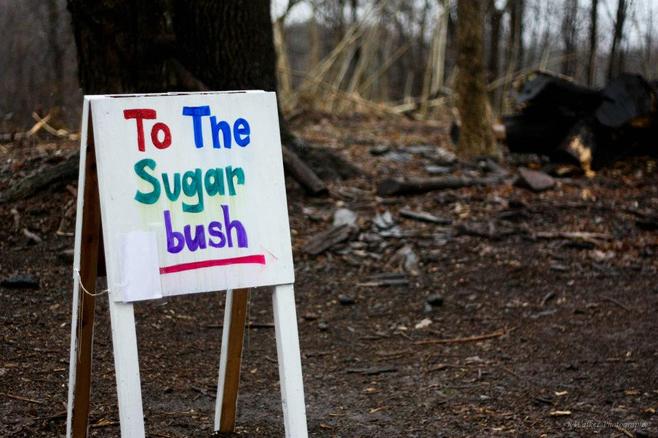
The season is short and subject to weather conditions. The traditional maple sugaring season in Connecticut extends from early February until late March, depending greatly on the weather. Freezing nights and warm, sunny days are necessary for the sap to flow from the maple tree. Sap is a colorless liquid with a light, sweet taste – about 2% sugar out of the tree. It is when the sugarmaker anticipates the right weather conditions that he/she will make his/her determination to tap the trees. Once the trees are tapped, the season lasts for 6-8 weeks until the nightly freeze no longer happens and the sap stops flowing or the trees start to form buds for their leaves. It is then time for the sugarmaker to thoroughly clean and store his equipment until the next sugaring season.
The sugar maple is the primary source for tapping. The most common tree the sugarmaker selects is the sugar maple, Acer saccharum. These trees grow in the northeast quadrant of the United States and around the Canadian Great Lakes. The maple trees the sugarmaker selects must be no smaller than 11 inches in diameter (about 40 years old) to be suitable for tapping.
Once the trees are tapped, it is up to the weather as to when the sap will flow. In late winter and spring sap is flowing up the tree every day but freezing nights and warm days are necessary for the maple tree to yield sap for the sugarmaker. During the day the sugarmaker may check to see if the weather has been favorable for the sap to flow out of the tree. It is when the buckets and sap tanks contain sap that it is time to collect the sap from every bucket and tank, and transport it back to the sugarhouse. The task of collecting sap can have its challenges. It can be difficult to collect sap in a fresh snowfall or when the melting snow turns the ground to mud. Cold temperatures can freeze pumps, valves, hoses, and couplings. To limit these obstacles some sugarhouses are built at the foot of the sugarbush so the tubing can bring the sap from the tree directly into the sugarhouse.
Перевод «maple syrup» на русский
Канада располагает стратегическим запасом кленового сиропа для обеспечения глобальных поставок в случае чрезвычайной ситуации.
Five of these are unique to maple syrup.
Пять из этих соединений являются совершенно уникальными для кленового сиропа.
Try to completely abandon the use of refined sugar, replacing it with natural sweeteners — dates, honey or maple syrup.
Старайся полностью отказаться от употребления рафинированного сахара, заменяя его натуральными подсластителями — финиками, медом или кленовым сиропом.
The idea of mixing baking soda with maple syrup or honey seems contradictory because the cancer cells feed on sugar.
Идея смешать пищевую соду с кленовым сиропом или медом кажется странной, потому что, как мы знаем, раковые клетки питаются сахаром.
Unsurprisingly, Canada is the world’s largest maple syrup producer.
Примечательно Дело в том, что Канада является крупнейшим в мире производителем кленового сиропа.
Don’t leave Canada without a bottle of maple syrup.
Ни один турист не уедет из Канады без пары бутылочек кленового сиропа.
A regular supply of sugar or maple syrup wasn’t available in the area until much later.
Регулярная поставка сахара или кленового сиропа не была доступна в этом районе намного позже.
I’m sure you know the other weaknesses of these guys: hockey, maple syrup and. lotteries.
Наверняка вы знаете и другие слабости этих ребят: хоккей, кленовый сироп и. лотереи.
Another important observation is that the maple syrup had no effect on the proliferation of normal colonic epithelial cells.
Другим важным наблюдением является то, что кленовый сироп не оказывал влияния на пролиферацию нормальных эпителиальных клеток толстой кишки.
Avoid anything that contains maple syrup or maple sugar.
Избегайте всего, что содержит кленовый сироп или кленовый сахар.
In 2001, more than 1 million liters of maple syrup were produced.
В 2001 году было произведено более 1 млн. литров кленового сиропа.
There’s more to this country than maple syrup and ice hockey.
В этом государстве есть нечто большее, чем кленовый сироп и хоккей.
They were in business together, selling and trading maple syrup.
У них был общий бизнес по продаже и производству кленового сиропа.
The reception halls cater to large groups offering dishes complemented by maple syrup.
Приемные залы обслуживают большие группы, предлагая блюда, сдобренные кленовым сиропом.
Tom likes maple syrup on his pancakes.
Том любит кленовый сироп на оладьях.
We used to make bongs out of maple syrup jugs.
А мы делали бонг из бутылки от кленового сиропа.
With a spinach, basil and walnut puree maple syrup.
Со шпинатом, базиликом, тертым грецким орехом и кленовым сиропом.
I was under the impression it tastes like maple syrup.
Я думал, она на вкус как кленовый сироп.
Возможно неприемлемое содержание
Примеры предназначены только для помощи в переводе искомых слов и выражений в различных контекстах. Мы не выбираем и не утверждаем примеры, и они могут содержать неприемлемые слова или идеи. Пожалуйста, сообщайте нам о примерах, которые, на Ваш взгляд, необходимо исправить или удалить. Грубые или разговорные переводы обычно отмечены красным или оранжевым цветом.
Зарегистрируйтесь, чтобы увидеть больше примеров. Это просто и бесплатно
Ничего не найдено для этого значения.
Предложить пример
Больше примеров Предложить пример
Новое: Reverso для Windows
Переводите текст из любого приложения одним щелчком мыши .
Скачать бесплатно
Перевод голосом, функции оффлайн, синонимы, спряжение, обучающие игры
Результатов: 777 . Точных совпадений: 777 . Затраченное время: 70 мс
Помогаем миллионам людей и компаний общаться более эффективно на всех языках.
How Maple Syrup is Made
Pure maple syrup is made by concentrating the slightly sweet sap of the sugar maple tree. The basics needed for making maple syrup therefore are some sugar maple trees and a method of concentrating the sap into syrup. As winter comes to an end, usually in late February or early March, sugarmakers prepare for their annual harvest of the maple trees. The group of maple trees that is used is called a sugarbush, or maple orchard. The sugarmaker prepares his or her sugarbush by clearing access roads in the snow, removing fallen branches, and setting up buckets or sap tubing systems. Whether they use tubing or buckets, sugarmakers must be sure that all their sap gathering, collecting, evaporating, and bottling equipment is absolutely clean and in good condition before the beginning of the season.
The beginning of the season
There is no set time when a sugarmaker must tap the trees. They must be aware of the clues of nature to tell when the time is right.
- Temperatures are not as extreme as earlier in the winter.
- Streams run with melting snow and icicles drip faster.
- Crows can be heard announcing the not-too-distant arrival of spring.
Mostly what the sugarmaker is waiting for is the arrival of the time of year known as “sugar weather,” when the nights are below freezing and the days are mild. This is the type of weather that makes the sap flow.
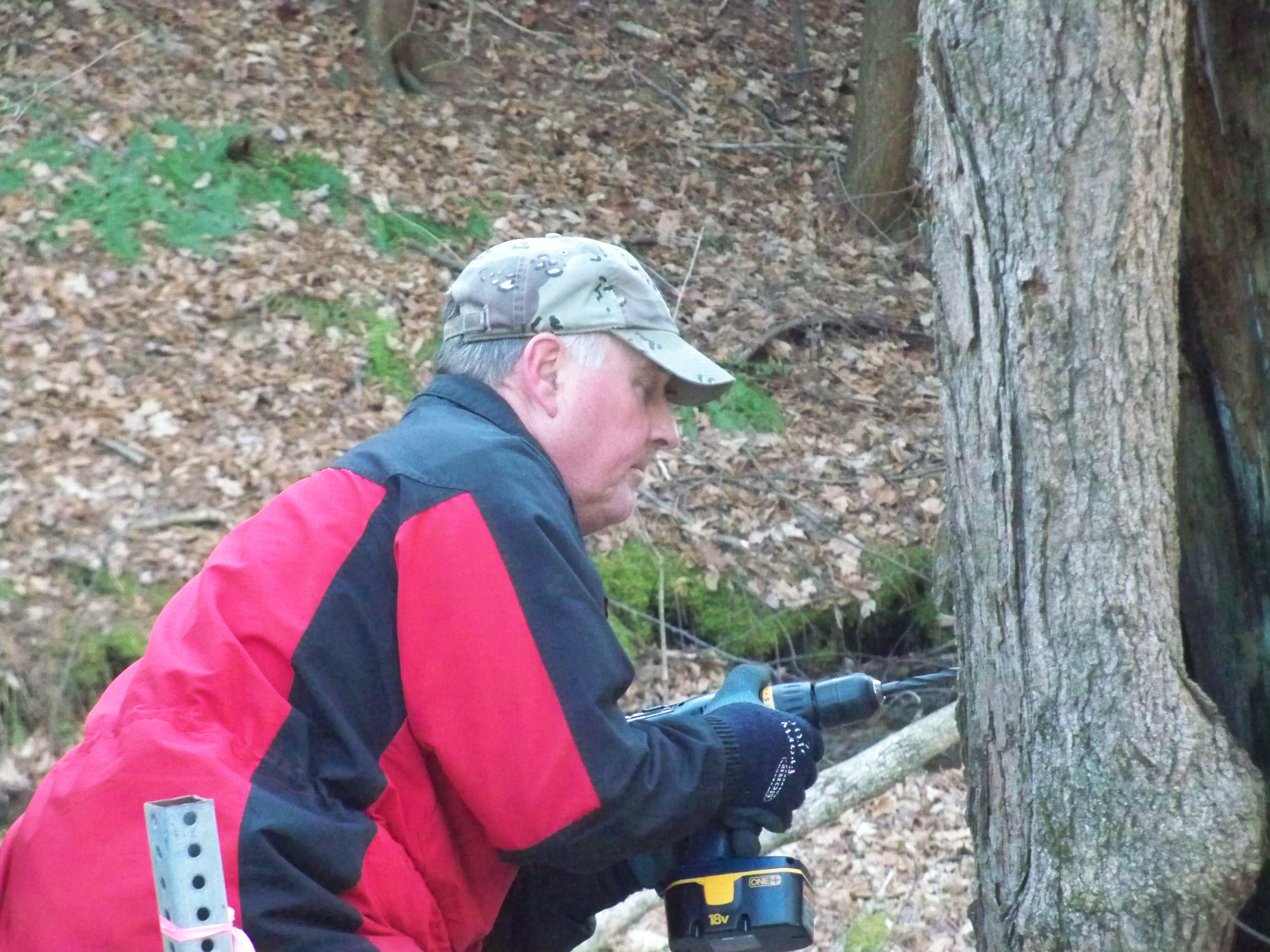
When the sugarmaker feels the time is “right” they will start to tap trees. Tapping involves going from tree to tree in the sugarbush, drilling holes into the wood which carries the sap. If buckets are used to collect the sap, a metal spout or “spile” is tapped snugly into the hole, and a bucket is hung from a hook on the spout. A cover is put on the bucket to keep out rain, snow, and debris. If a plastic tubing system is used to collect the sap, a plastic spout, which is connected to the pipeline system, is tapped into the hole in the tree.
The maple tree must be a least 10 inches in diameter and in good health before it can be tapped. It usually takes about forty years before a tree will reach tappable size. The hole is usually placed about waist high on the tree, and not near previous tapholes. Larger trees may take as many as three or four taps, but only if they are healthy. The sugarmaker has a feeling of respect for his trees and knows they must take care of this tree which provides for them. Trees that are in poor health or have been defoliated by insects are often tapped less, or not tapped at all. If proper tapping procedures are followed, tapping will not endanger the health and vitality of the tree. A healthy sugar maple can provide sap every year for a hundred years or more.
sap yield
Throughout the 4–6 week sugar season, each tap hole will yield approximately ten gallons of sap. This is only a small portion of the tree’s total sap production and will not hurt the tree. The average amount of syrup that can be made from this ten gallons of sap is about one quart. These amounts vary greatly from year to year, and depend upon the length of the season, the sweetness of the sap, and many complex conditions of nature, such as weather conditions, soil, tree genetics, and tree health.
sap flow is governed by the weather
When the trees have been tapped and all the equipment is ready, the sugarmaker is ready for the “first run,” that exciting time of the year when the sap first starts to flow, sap flow requires freezing nights and warm (but not hot) days. These must alternate and be in long enough series to allow the sap to move in the trees. For the first time each season the sap will drip into a bucket or slowly start to flow down the tubing system towards a collection tank. Prolonged periods of either below freezing temperatures or days without freezing nights will stop the sap flow. As a result, sugarhouses often start and stop boiling at different times due to local climatological factors. The gentle geographic progression is a reverse of the fall foliage season. That is, the lower elevations and more southern regions of Massachusetts usually start their maple seasons before the higher elevations and more northerly areas. Prolonged warm spells or cold snaps during the season may halt sap flow for several days, and it may start again when conditions are favorable. As a result, 24-hour work days are often interspersed with two, three or even more days of relative inactivity. This gives the sugarmaker a chance to recover lost sleep, make repairs, clean equipment, and get ready for the next sap “run.”
sugar content
Maple sap, as it comes from the tree is a clear, slightly sweet liquid.
- The sugar content ranges from one to four percent.
- A device called a “hydrometer” can be floated in the sap to determine the exact sugar content.
- Sweeter sap is favored because less water will have to be evaporated to make maple syrup.
- The sap must be evaporated as soon as possible because the freshest sap makes the best quality syrup.
Where the bucket collection method is used, a sap gathering tank is mounted on a sled, wagon, or truck, and is moved through the sugarbush as the sap is gathered. Tractors are most often used, but sometimes teams of horses or even oxen pull the sleds or wagons.
- The sap is collected from each tree by workers using large gathering pails.
- These pails are dumped into the gathering tank, which is then taken to a large sap storage tank at the sugarhouse, where it will soon be boiled down into pure maple syrup.
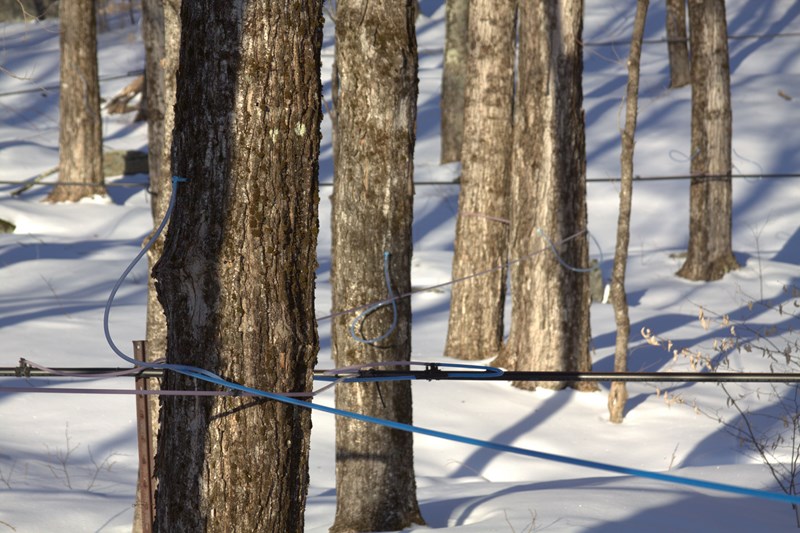
- If the tubing system is being used, the sap drips from the taphole, through the spout, and into a network of plastic tubing.
- This tubing is joined to other trees, and eventually turns into a larger pipeline called a “mainline.”
- The mainline carries the sap downhill to a sap storage tank either at the sugarhouse, or at a low spot where it can be collected easily and transported to the sugarhouse.
the sugarhouse and evaporator
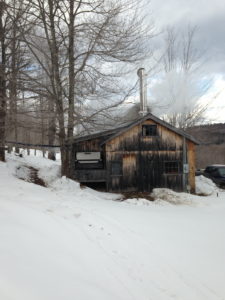
Maple syrup is traditionally made in a building called a “sugarhouse” — the name of the building comes from the time when most sap was actually turned into sugar. Sugarhouses vary in size and shape, each with its own character. Some may be rustic wood buildings out in the woods with poor access and no electricity, full of old tools and memories of grandfather’s sugar seasons of the past. Still others might remind you of a modern food processing plant, brightly lit and streamlined. Each sugarhouse will have vent at the top, a cupola, which is opened to allow the steam of the boiling syrup to escape the building. All throughout the maple producing regions, steam rising from the cupola is a signal that maple syrup season is under way.
Antique or modern, each sugarhouse will contain an evaporator used to boil down the sap into syrup.
- Evaporators are made up of one or more flat pans which sit on an “arch,” a type of firebox.
- Wood, oil, gas, wood chips or wood pellets are burned at the front end, and the flames are drawn along the underside of the pan, heating and boiling the sap as they travel towards the rear.
- It commonly takes about one cord of wood or sixty gallons of oil to boil down 800 gallons of sap into maple syrup.
- Depending on the size of the evaporator and the number of trees tapped, this may represent anywhere from two hours to two whole days of boiling.
The basic design of maple syrup evaporators has changed little over the years, although sugarmakers are always tinkering with new designs to make the process faster or more fuel efficient. The size of the evaporator depends on the number of trees a producer has tapped. Most are from two feet wide and six feet long, up to six feet wide by twenty feet long. Many backyard and hobby sugarmakers use smaller arrangements, or boil down their sap on the kitchen stove.

An evaporator pan is divided into partitions, so that the sap is continuously flowing through the pan. Fresh sap enters at the back of the pan, where a float valve keeps the sap about an inch deep. As the water is boiled off, two things happen: First, the liquid becomes sweeter, and begins to move towards the front of the pan, traveling through the partitions. Secondly, more fresh sap is allowed into the rear of the pan. In this way the water is constantly being evaporated away, the liquid is becoming sweeter as it moves towards the front of the pan, and the float valve in the rear is always allowing more sap to be added to keep the level about an inch deep. It takes about forty gallons of this slightly sweet sap, boiled down, to make one gallon of pure maple syrup.
The sugarmaker concentrates their attention to the front of the evaporator where the boiling sap is turning a golden color as it approaches being maple syrup. From time to time they will check the temperature of the boiling liquid. When it reaches seven and a half degrees above the boiling point of water, it has reached proper density and has become maple syrup. Another way of checking for the proper density or sugar content is to place a scoop into the boiling syrup. If the drops along the bottom edge of the scoop begin to hold together like a sheet or apron, then the sugarmaker knows the syrup is done. Coming from the tree, maple sap is approximately 98% water and 2% sugar. When the syrup is finished, it is only 33% water and 67% sugar.
At this stage a valve on the front of the pan is opened and some of the finished boiling syrup is drawn off the pan and is filtered. After filtering, the syrup is bottled and is ready for sale or ready for a fresh pile of warm pancakes.
all good things come to an end
The length of the sugaring season is totally dependent upon the weather. It may last only a few weeks, or as long as six or eight weeks. As the days become increasingly warmer, and the nights rarely get below freezing, the buds on the branches of the maple trees begin to swell, marking the end of the season. Chemical changes take place within the tree as baby leaves begin to form within the buds. At this time the sap is no longer suitable for boiling down into syrup. Sugarmakers know it is now time to clean up all the buckets, spouts, tanks, and miles of tubing with plenty of hot water so that the equipment can be put into storage and ready for the next winter.
Massachusetts Maple Producers Association