What is the IIS equivalent of a rewrite rule that sends all requests to a PHP file?
I’ve always used Apache for all my web development work and I’m struggling to get my head around IIS. I’ve got an API that re-routes all requests to one particular file: ‘api.php’, how would I do the following in IIS:
RewriteEngine on RewriteRule ^/.* /api.php My server only allows web.config files to achieve this so I have no access to IIS manager, or anything of that nature. I’m using IIS 7.5.
98.2k 16 16 gold badges 136 136 silver badges 358 358 bronze badges
URL Rewrite
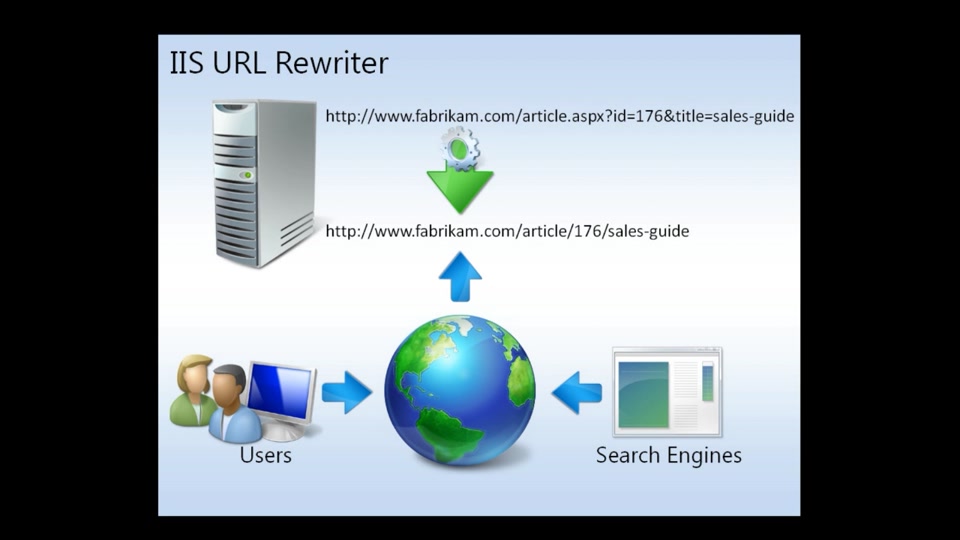
IIS URL Rewrite 2.1 enables Web administrators to create powerful rules to implement URLs that are easier for users to remember and easier for search engines to find. By using rule templates, rewrite maps, .NET providers, and other functionality integrated into IIS Manager, Web administrators can easily set up rules to define URL rewriting behavior based on HTTP headers, HTTP response or request headers, IIS server variables, and even complex programmatic rules. In addition, Web administrators can perform redirects, send custom responses, or stop HTTP requests based on the logic expressed in the rewrite rules.
Define powerful rules to transform complex URLs into simple and consistent Web addresses
URL Rewrite allows Web administrators to easily build powerful rules using rewrite providers written in .NET, regular expression pattern matching, and wildcard mapping to examine information in both URLs and other HTTP headers and IIS server variables. Rules can be written to generate URLs that can be easier for users to remember, simple for search engines to index, and allow URLs to follow a consistent and canonical host name format. URL Rewrite further simplifies the rule creation process with support for content rewriting, rule templates, rewrite maps, rule validation, and import of existing mod_rewrite rules.
Easily replace Web application URLs to produce user and search engine friendly results
URL Rewrite permits Web administrators to easily replace the URLs generated by a Web application in the response HTML with a more user friendly and search engine friendly equivalent. Links can be modified in the HTML markup generated by a Web application behind a reverse proxy. URL Rewrite makes things easier for outbound response content and headers rewriting with outbound rewrite rules that work with HTTP request and response headers and with IIS server variables.
Seamless integration with existing IIS features that improve management, performance, and troubleshooting
URL Rewrite is tightly integrated with IIS Manager for better management. In addition, URL Rewrite supports both user-mode and kernel-mode caching for faster performance. URL Rewrite also supports Failed Request Tracing for enhanced troubleshooting of application logic execution.
Features
- Rules-based URL rewriting engine
- Rules-based response rewriting engine
- Support for custom .NET rewrite providers
- Regular expression pattern matching
- Wildcard pattern matching
- Global and distributed rewrite rules
- Rewriting within the content of specific HTML tags
- Pre-conditions for outbound rules
- Access to server variables and HTTP headers
- Rewriting of server variables and HTTP request headers
- Rewriting of HTTP response headers
- Allow list for server variables
- HtmlEncode function
- Built-in rule templates
- Reverse proxy rule template
- Rule templates for Search Engine Optimization
- Various rule actions including redirect and request abort
- Tracking capture groups across rule conditions
- Logging of rewritten URLs
- Updated user interface in IIS Manager
- Integrated user interface for managing rewrite rules and rewrite maps
- Integrated user interface for importing of Apache mod_rewrite rules
- Integrated user interface for testing regular expression and wildcard patterns
- Support for IIS kernel-mode and user-mode output caching
- Lowercase conversion function
- Rewrite maps to generate the substitution URL during rewriting
- Failed Request Tracing support
Awards

Download URL Rewrite Module 2.1
- English: x86 installer / x64 installer
- German: x86 installer / x64 installer
- Spanish: x86 installer / x64 installer
- French: x86 installer / x64 installer
- Italian: x86 installer / x64 installer
- Japanese: x86 installer / x64 installer
- Korean: x86 installer / x64 installer
- Russian: x86 installer / x64 installer
- Chinese Simplified: x86 installer / x64 installer
- Chinese Traditional: x86 installer / x64 installer
Download Extensibility Samples
The extensibility samples provide .NET assemblies and the source code with full implementation of rewrite providers for the three most common use cases: storing of the rewrite or redirect mappings in a SQL database; storing of the rewrite or redirect mappings in a text file; storing of the lookup substrings in a text file.
- This site is managed for Microsoft by Neudesic, LLC. | © 2023 Microsoft. All rights reserved.
- Privacy Statement
- Terms of Use
- Contact Us
- Hosted on Microsoft Azure
- Advertise with Us
- Manage cookies
- California Consumer Privacy Act (CCPA) Opt-Out Icon
- Follow us on:
- Microsoft
- Feedback on IIS
How to do URL re-writing in PHP?
I am trying to implement URL rewriting in my PHP application. Can someone share a step by step procedure of implementing URL rewriting in PHP and MySQL? In my application I want to implement following URL rewriting, I want to redirect
1. http://example.com/videos/play/google-io-2009-wave-intro 2. http://example.com/videos/play/203/google-io-2009-wave-intro 1. http://example.com/videos/play.php?title=google-io-2009-wave-intro 2. http://example.com/videos/play.php?id=203 Please tell me how to implement both URL rewriting in any of the above way. One more thing which URL will be best according to SEO, management, application point-of-view out of the following two types.
1. http://example.com/videos/play/google-io-2009-wave-intro 2. http://example.com/videos/play/203/google-io-2009-wave-intro 20k 18 18 gold badges 102 102 silver badges 189 189 bronze badges
asked Jun 24, 2009 at 17:17
26.7k 70 70 gold badges 166 166 silver badges 228 228 bronze badges
I think this was asked before. Look here my complete solution for this.
Jun 24, 2009 at 17:50
Here is a good tutorial from Nettuts on mod_rewrite.
Sep 26, 2009 at 18:48
9 Answers 9
Typically this will be nothing more than enabling the mod_rewrite module (you likely already have it enabled with your host), and then adding a .htaccess file into your web-directory. Once you’ve done that, you are only a few lines away from being done. The tutorial linked above will take care of you.
Just for fun, here’s a Kohana .htaccess file for rewriting:
# Turn on URL rewriting RewriteEngine On # Installation directory RewriteBase /rootDir/ # Protect application and system files from being viewed RewriteRule ^(application|modules|system) - [F,L] # Allow any files or directories that exist to be displayed directly RewriteCond % !-f RewriteCond % !-d # Rewrite all other URLs to index.php/ RewriteRule .* index.php/$0 [PT,L] What this will do is take all requests and channel them through the index.php file. So if you visited www.examplesite.com/subjects/php, you may actually be visiting www.examplesite.com/index.php?a=subjects&b=php.
If you find these URLs attractive, I would encourage you to go one step further and check out the MVC Framework (Model, View, Controller). It essentially allows you to treat your website like a group of functions:
public function jokes ($page = 1)
public function jokes ($page = 1)
Notice how the first forward slash calls a function, and all that follow fill up the parameters of that function. It’s really very nice, and make web-development much more fun!
URL Rewrite Module Configuration Reference
This article provides an overview of the URL Rewrite Module and explains the configuration concepts that are used by the module.
Functionality Overview
The URL Rewrite Module rewrites request URLs to simple, user-friendly, and search-engine friendly addresses that are displayed to users or in Web applications. URL Rewrite uses defined rules to evaluate and then map the request URL to the address defined in the rule before it is processed by an IIS Web server. You can define URL rewriting logic that includes regular expressions and wildcards, and rules can be applied based on the request URL, HTTP headers, and server variables. While the primary purpose of the module is to rewrite request URLs to more friendly URLs, you can also use the module to define rules that perform redirects, send custom responses, or abort requests.
Rewrite Rules Overview
A rewrite rule defines the logic of what to compare or match the request URL with, and what to do if the comparison is successful.
Rewrite rules consists of the following parts:
- Pattern – The rule pattern is used to specify either the regular expression or a wildcard pattern that is used to match URL strings.
- Conditions – The optional conditions collection is used to specify additional logical operations to perform if a URL string matches the rule pattern. Within the conditions, you can check for certain values of HTTP headers or server variables, or verify if the requested URL corresponds to a file or directory on a physical file system.
- Action – The action is used to specify what to do if the URL string matches the rule pattern and all the rule conditions are met.
Rewrite Rules Scope
Rewrite rules can be defined in two different collections:
- – Rules in this collection can be defined only on the server level. Global rules are used to define server-wide URL rewriting logic. These rules are defined within the ApplicationHost.config file, and they cannot be overridden or disabled on any lower configuration levels. Global rules always operate on the absolute URL’s path (that is, the requested URI without the server name). These rules are evaluated early in the IIS request-processing pipeline (PreBeginRequest event).
- – Rules in this collection are called distributed rules, and they can be defined on any level in the configuration hierarchy. Distributed rules are used to define URL rewriting logic specific to a particular configuration scope. This type of rule can be added on any configuration level by using Web.config files or by using tags within ApplicationHost.config or Web.config files. Distributed rules operate on the URL path, relative to the location of the Web.config file where they are defined. In cases where distributed rules are defined inside of a tag, they operate on the URL path, relative to the path specified for that tag. These rules are evaluated on the BeginRequest event in the IIS pipeline.
Rules Evaluation
Each configuration level in IIS can have zero or more rewrite rules defined. The rules are evaluated in the same order in which they are specified. The URL Rewrite Module processes the set of rules by using the following algorithm:
- First, the URL is matched against the pattern of a rule. If it does not match, the URL Rewrite Module immediately stops processing that rule, and goes on to the next rule.
- If a pattern matches and there are no conditions for the rule, the URL Rewrite Module performs the action specified for this rule and then goes on to the next rule, where it uses the substituted URL as an input for that rule.
- If a pattern matches and there are conditions for the rule, the URL Rewrite Module evaluates the conditions. If the evaluation is successful, the specified rule action is performed, and then the rewritten URL is used as input to the subsequent rule
A rule may have the StopProcessing flag turned on. When the rule action is performed (i.e. the rule matched) and this flag is turned on, it means that no more subsequent rules will be processed and the request will be passed to the IIS request pipeline. By default, this flag is turned off.
Rules Inheritance
If rules are defined on multiple configuration levels, the URL Rewrite Module evaluates the rules in the following order:
- Evaluate all the global rules.
- Evaluate a rule set that includes distributed rules from parent configuration levels as well as rules from the current configuration level. The evaluation is performed in a parent-to-child order, which means that parent rules are evaluated first and the rules defined on a last child level are evaluated last.
Preserving Original URL
The URL Rewrite Module preserves the original requested URL path in the following server variables:
- HTTP_X_ORIGINAL_URL – this server variable contains the original URL in decoded format;
- UNENCODED_URL – this server variable contains the original URL exactly as it was requested by a Web client, with all original encoding preserved.
Accessing URL Parts from a Rewrite Rule
It is important to understand how certain parts of the URL string can be accessed from a rewrite rule.
For an HTTP URL in this form: http(s)://:/?
- The is matched against the pattern of the rule.
- The is available in the server variable called QUERY_STRING and can be accessed by using a condition within a rule.
- The is available in the server variable HTTP_HOST and can be accessed by using a condition within a rule.
- The is available in the server variable SERVER_PORT and can be accessed by using a condition within a rule.
- Server variables SERVER_PORT_SECURE and HTTPS can be used to determine if a secure connection was used. These server variables can be accessed by using a condition within a rule.
- The server variable REQUEST_URI can be used to access the entire requested URL path, including the query string.
For example, if a request was made for this URL: http://www.mysite.com/content/default.aspx?tabid=2&subtabid=3 , and a rewrite rule was defined on the site level then:
- The rule pattern gets the URL string content/default.aspx as an input.
- The QUERY_STRING server variable contains tabid=2&subtabid=3 .
- The HTTP_HOST server variable contains www.mysite.com .
- The SERVER_PORT server variable contains 80 .
- The SERVER_PORT_SECURE server variable contains 0 and HTTPS contains OFF .
- The REQUEST_URI server variable contains /content/default.aspx?tabid=2&subtabid=3 .
- The PATH_INFO server variable contains /content/default.aspx .
Note that the input URL string passed to a distributed rule is always relative to the location of the Web.config file where the rule is defined. For example, if a request is made for http://www.mysite.com/content/default.aspx?tabid=2&subtabid=3 , and a rewrite rule is defined in the /content directory, then the rule gets this URL string default.aspx as an input.
Rewrite Rule Configuration
Rule Pattern
A rewrite rule pattern is used to specify a pattern to which the current URL path is compared. Current, in this context, means the value of the URL path when the rule is applied. If there were any rules that preceded the current rule, they may have matched the original requested URL and modified it. The URL string that is evaluated against the pattern does not include the query string. To include the query string in the rule evaluation you can use the QUERY_STRING server variable in the rule’s condition. For more information, refer to «Using server variables in rewrite rules».
A pattern is specified within a element of a rewrite rule.
Rule pattern syntax
Rule pattern syntax can be specified by using the patternSyntax attribute of a rule. This attribute can be set to one of the following options:
ECMAScript – Perl compatible (ECMAScript standard compliant) regular expression syntax. This is a default option for any rule. This is an example of the pattern format: «^([_0-9a-zA-Z-]+/)?(wp-.*)»
Wildcard – Wildcard syntax used in IIS HTTP redirection module. The following is an example of a pattern in this format: «/Scripts/*_in. «, where asterisk («*») means «match any number of any characters and capture them in a back-reference» and «?» means match exactly one character (no back-reference is created).
The scope of the patternSyntax attribute is per rule, meaning that it applies to the current rule’s pattern and to all patterns used within conditions of that rule.
Rule pattern properties
A pattern can be negated by using the negate attribute of the element. When this attribute is used, the rule action is performed only if the current URL does not match the specified pattern.
By default, case-insensitive pattern matching is used. To enable case sensitivity, you can use the ignoreCase attribute of the element of the rule.
Rule conditions
Rule conditions allow defining additional logic for rule evaluation, which can be based on inputs other than just a current URL string. Any rule can have zero or more conditions. Rule conditions are evaluated after the rule pattern match is successful.
Conditions are defined within a collection of a rewrite rule. This collection has an attribute called logicalGrouping that controls how conditions are evaluated. If a rule has conditions, then the rule action is performed only if rule pattern is matched and:
- All conditions were evaluated as true, provided that logicalGrouping=»MatchAll» was used.
- At least one of the conditions was evaluated as true, provided that logicalGrouping=»MatchAny» was used.
A condition is defined by specifying the following properties:
- Input string
- Match type
Condition input specifies which item to use as an input for the condition evaluation. Condition input is an arbitrary string that can include server variables and back-references to prior condition patterns and/or to rule patterns.
The match type can be one of the following three options:
- IsFile – This match type is used to determine whether the input string contains a physical path to a file on a file system. If a condition input string is not specified, the URL Rewrite Module uses the physical path of the requested file as a default value for the condition input. This match type can be used only for distributed rules.
- IsDirectory – This match type is used to determine whether the input string contains a physical path to a directory on a file system. If a condition input string is not specified, the URL Rewrite Module uses the physical path of the requested file as a default value for the condition input. This match type can be used only for distributed rules.
- Pattern – This match type is used to express a condition where an arbitrary input string is matched against a regular expression pattern. A condition pattern can be specified by using either regular expression syntax or by using wildcard syntax. The type of pattern to use in a condition depends on the value of the patternSyntax flag defined for the rule to which this condition belongs. This condition type has two related attributes that control pattern matching:
- pattern – Use this attribute to specify the actual pattern.
- ignoreCase – Use this attribute to control whether pattern matching for the condition should be case sensitive or case insensitive.
In addition, the result of the condition evaluation can be negated by using the negate attribute. This can be used to specify a condition that checks if the requested URL is NOT a file, as in the following example:
" matchType="isFile" negate="true">Rule action
A rewrite rule action is performed when the current URL matches the rule pattern and the condition evaluation succeeded (depending on the rule configuration, either all conditions matched or any one or more of the conditions matched). There are several types of actions available, and the type attribute of the configuration element can be used to specify which action the rule performs. The following sections describe different action types and the configuration options related to specific action types.
Rewrite action
A Rewrite action replaces the current URL string with a substitution string. A substitution string must always specify the URL path (for example, contoso/test/default.aspx). Note that substitutions that contain a physical path on a file system (for example, C:\inetpub\wwwroot ) are not supported in IIS.
A Rewrite action has the following configuration options:
- url – This is the substitution string to use when rewriting the current URL. The substitution URL is a string value that can include the following:
- Back-references to the condition and rule patterns. (For more information, see the section about how to use back-references.)
- Server variables. (For more information, see the section about how to use server variables.)
Redirect action
A Redirect action instructs the URL Rewrite Module to send a redirect response back to the client. The redirect status code (3xx) can be specified as a parameter for this action. The Location field of the response contains the substitution string specified in the rule.
The substitution URL for the redirect rule can be specified in one of the following forms:
- Relative URL path – contoso/test/default.aspx
- Absolute URI – https://example.com/contoso/test/default.aspx
Usage of a Redirect action implies that no subsequent rules evaluated for the current URL after redirection is performed.
A Redirect action has the following configuration options:
- url – Uses a substitution string as a redirection URL. A substitution URL is a string that can include the following:
- Back-references to the condition and rule patterns. (For more information, see the section about how to use back-references.)
- Server variables. (For more information, see the section about how to use server variables.)
- 301 – Permanent
- 302 – Found
- 303 – See other
- 307 – Temporary
CustomResponse action
A CustomResponse action causes the URL Rewrite Module to respond to the HTTP client by using a user-specified status code, subcode, and reason. Use of a CustomResponse action implies that no subsequent rules are evaluated for the current URL after this action is performed.
CustomResponse action has the following configuration options:
- statusCode– Specifies the status code to use in response to the client.
- subStatusCode – Specifies the substatus code to use in response to the client.
- statusReason – Specifies the reason phrase to use with the status code.
- statusDescription – Specifies the one line description to put in the body of the response.
AbortRequest action
An AbortRequest action causes the URL Rewrite Module to drop the HTTP connection for the current request. The action does not have any parameters. Use of this action implies that no subsequent rules are evaluated for the current URL after this action is performed.
None action
A None action is used to specify that no action is performed.
Using server variables in rewrite rules
Server variables provide additional information about current HTTP requests. You can use this information to make rewriting decisions or to compose the rewritten URL. Server variables can be referenced in the following locations within rewrite rules:
- In the condition input string
- In rule substitution strings, specifically:
- url attribute of Rewrite and Redirect action
- statusLine and responseLine of a CustomResponse action
Server variables can be referenced by using the syntax. For example, the following condition uses the QUERY_STRING server variable:
" pattern="id=([0-9]+)" />Server variables can also be used to access HTTP headers from the current request. Any HTTP header supplied by the current request is represented as a server variable that has a name generated in accordance to this naming convention:
- All dash («-«) symbols in the HTTP header name are converted to underscore symbols («_»).
- All letters in the HTTP header name are converted to capital case.
- «HTTP_» prefix is added to the header name.
For example, in order to access the HTTP header «user-agent» from a rewrite rule, you can use the server variable.
Using back-references in rewrite rules
Parts of rules or conditions inputs can be captures in back-references. These can be then used to construct substitution URLs within rules actions or to construct input strings for rule conditions.
Back-references are generated in different ways, depending on which kind of pattern syntax is used for the rule. When an ECMAScript pattern syntax is used, a back-reference can be created by putting parenthesis around the part of the pattern that must capture the back-reference. For example, the pattern ([0-9]+)/([a-z]+).html will capture 07 and article in back-references from this requested URL: 07/article.html. When «Wildcard» pattern syntax is used, the back-references are always created when an asterisk symbol (*) is used in the pattern. No back-references are created when «?» is used in the pattern. For example the pattern */*.html will capture contoso and test in back-references from this requested URL: contoso/test.html.
Usage of back-references is the same regardless of which pattern syntax was used to capture them. Back-references can be used in the following locations within rewrite rules:
- In condition input strings
- In rule actions, specifically:
- url attribute of Rewrite and Redirect action
- statusLine and responseLine of a CustomResponse action
Back-references to condition patterns are identified by where N is from 0 to 9. Back-references to rule patterns are identified by where N is from 0 to 9. Note that for both types of back-references, and , will contain the matched string.
For example, in this pattern:
For the string: www.foo.com the back-references will be indexed as follows:
- www.foo.com - www. - foo.comWithin a rule action, you can use the back-references to the rule pattern and to the last matched condition of that rule. Within a condition input string, you can use the back-references to the rule pattern and to the previously matched condition.
The following rule example demonstrates how back-references are created and referenced:
" type="Pattern" pattern="^([^.]+)\.mysite\.com$" /> /" />Interaction with IIS Output Caching
The URL Rewrite Module controls the IIS output cache behavior in order to:
- Optimally utilize kernel mode and user mode output caching of responses for rewritten URLs, thus improving performance of the Web application that uses URL Rewrite Module.
- Prevent caching of responses, when caching logic may be violated due to URL rewriting.
The module controls output caching either by altering certain caching properties or by disabling the caching altogether. The module cannot enable output caching if it has been disabled by IIS configuration or by any other module in the IIS pipeline. The output caching is controlled as follows:
- The module always sets the user mode cache setting varyByHeader=»HTTP_X_ORIGINAL_URL». This ensures that when user mode caching is enabled the module takes into account the original URL to construct a key for the cache entry.
- If a rewrite rule set uses server variables with values that are either constant throughout the life of the process or are derived from the requested URL, the rule set is considered safe for output caching. This means that the URL Rewrite Module will not alter existing caching policy in any way other than setting varyByHeader as described in step 1. The following server variables, when used in rewrite rules, do not cause any effect on output caching policy:
- «CACHE_URL»
- «DOCUMENT_ROOT»
- «HTTP_URL»
- «HTTP_HOST»
- «PATH_INFO»
- «PATH_TRANSLATED»
- «QUERY_STRING»
- «REQUEST_FILENAME»
- «REQUEST_URI»
- «SCRIPT_FILENAME»
- «SCRIPT_NAME»
- «SCRIPT_TRANSLATED»
- «UNENCODED_URL»
- «URL»
- «URL_PATH_INFO»
- «»APP_POOL_ID»
- «APPL_MD_PATH»
- «APPL_PHYSICAL_PATH»
- «GATEWAY_INTERFACE»
- «SERVER_SOFTWARE»
- «SSI_EXEC_DISABLED»
- If a rewrite rule set uses any server variable not mentioned in the above list, the rule set is considered unsafe for output caching. This means that the URL Rewrite Module will disable kernel mode caching for all requests whether the request URLs were rewritten or not. In addition, the module will alter the caching policy for user-mode cache by setting the caching property varyByValue to contain the concatenated string of all server variables values used in the rule set.
String functions
There are three string functions available for changing the values within a rewrite rule action, as well as any conditions:
- ToLower — returns the input string converted to lower case.
- UrlEncode — returns the input string converted to URL-encoded format. This function can be used if the substitution URL in rewrite rule contains special characters (for example non-ASCII or URI-unsafe characters).
- UrlDecode — decodes the URL-encoded input string. This function can be used to decode a condition input before matching it against a pattern.
The functions can be invoked by using the following syntax:
Where «function_name» can be on eof the following: «ToLower», «UrlEncode», «UrlDecode». «Any_string» can be either a literal string or a string built by using server variables or back-references. For example, the following are valid invocations of string functions:
> .aspx?p=[résumé]>The string functions can be used in the following locations within rewrite rules:
- In condition input strings
- In rule substitution strings, specifically:
- url attribute of Rewrite and Redirect actions
- statusLine and responseLine attributes of a CustomResponse action
An example of a rule that uses the ToLower function:
" type="Pattern" pattern="^www\.mysite\.com$" negate="true" /> >" redirectType="Found" />An example of a rule that uses the UrlEncode function:
An example of a rule that uses the UrlDecode function:
>" pattern="résumé" /> Rewrite maps
A rewrite map is an arbitrary collection of name-value pairs that can be used within rewrite rules to generate the substitution URL during rewriting. Rewrite maps are particularly useful when you have a large set of rewrite rules and all of these rules use static strings (that is, when there is no pattern matching used). In those cases, instead of defining a large set of simple rewrite rules, you can put all the mappings into the rewrite map as keys and values between the input URL and the substitution URL. Then, to look up the substitution URL based on the input URL, you will have one rewrite rule that references the rewrite map.
A rewrite map defines a named collection of name-value pair strings, as in the following example:
A rewrite map is uniquely identified by its name and can contain zero or more key-value entries. In addition, a rewrite map can specify the default value to use when a key is not found. This is controlled by using the defaultValue attribute. By default, an empty string is used as a default value.
There can be any number of rewrite maps on any configuration level, except the file level. Rewrite maps are located within collection element.
Rewrite maps are referenced within a rewrite rule by using the following syntax:
Where the Key parameter can be any arbitrary string, and can include back-references to rule or condition patterns. For example, the following are valid uses of a rewrite map:
/test/> ?&contoso=test>A reference to a rewrite map gets substituted with the value that was looked up by using the key passed as a parameter within a rewrite map reference. If a key was not found, the default value for that rewrite map is used.
A Rewrite map can be referenced in the following locations within rewrite rules:
- In condition input string
- In rule substitution strings, specifically:
- url attribute of Rewrite and Redirect actions
- statusLine and responseLine of CustomResponse actions
Example 1: With a rewrite map defined as follows:
And a rewrite rule defined as follows:
>" pattern="(.+)" /> "/>Example 2: With a rewrite map defined as follows:
And a rewrite rule defined as follows:
>" pattern="(.+)" /> " redirectType="Found" />