KODAK HC 110 Developer 1000 ml conc.

Originally developed as a fast developer for press photographers, HC 110 is now widely used by large-format photographers and adherents of the Zone System. The reason? Wth this developer the negative contrast can be very precisely controlled and HC 110 takes advantage of the film’s full light sensitivity while producing good shadow details. This developer is not fine grained, however. It can be heavily diluted, and so is economical for sheet film developing or for use in a school photo lab. The short developing time ensures that the film is developed before the class bell rings!
Uncertainty Surrounds the Future of Kodak Photo Paper and Chemistry

Just about every industry has been touched by some form of supply chain issue in the past few years and photography has been no exception. But black and white film photographers might be taking the brunt of them soon.
In June 2020, Kodak Alaris sold their silver photochemical, paper, display, and software divisions to Sino Promise Group, a Chinese imaging company. By March 2022, reports began surfacing that Sino Promise was encountering serious financial trouble. Meanwhile, the cost to consumers for Kodak branded darkroom chemistry began ratcheting up. The last part was enough to dismiss, given how much everything seems to be going up in price lately.
Kodak HC-110 is Now Hard to Find
I am a working film photographer and shoot exclusively on hand-processed b&w 35mm film. For about fifteen years, I’ve depended faithfully on Kodak HC-110, a popular film developer formulated by the company back in 1962. Throughout each bump in the road since the rise of digital photography in the early 2000s, Kodak’s bankruptcy in 2012, and related film stock discontinuations, I’ve never had any difficulty buying plenty of HC-110. The chemical was even reformulated in 2019, but transitioning to it was nearly seamless for my particular workflow.
This is why I was shocked a few weeks ago when I started to make my annual purchase of six one-liter bottles and couldn’t find HC-110 for sale at any of my usual, trusted vendors such as Film Photography Project, Freestyle Photo, or Adorama. I noticed that HC-110 was not only on backorder, but the listed price had also increased by more than 50% at some stores since my last purchase in 2022.
B&H Photo had HC-110 in stock but they are located in New York City and do not ship chemicals considered to be hazmats. This barred me from ordering with them unless I drove the four-plus hour trip and was probably the precise reason that they seemed to be the only big retailer with any in stock.
A similar shortage happened last year to another staple product of mine, Kodak Tri-X 35mm film. I needed to order 30 rolls and had to buy what was left from multiple vendors (at higher prices too) in order to cover my upcoming shoots. Being in business, I don’t like to order supplies from anyone I don’t have a relationship with because I then feel the need to test them before use which is not a good use of my time and wastes money.
Kodak Alaris still markets Kodak film though, and the company has been very good about giving warnings ahead of price increases and product changes. So there was never a point where I was completely empty-handed with film, because I was given time to prepare.
But Sino Promise has not been as transparent or communicative with their Kodak-branded chemicals.

Troubling Reports from Vendors and Labs
I reached out to my vendors to find out what was going on and I got some troubling responses. Two told me that HC-110 was on backorder but no expected ship date had been provided. Mike Raso at Film Photography Project told me that he expected the shipment within about three weeks but also nudged me in the direction of his in-house HC-110 clone.
Having exhausted my regulars, I started looking elsewhere but it became clear I was scraping the bottom of an empty barrel.
I found some HC-110 listed as being in stock at Nelson Photo in San Diego, California. I encounter high shipping costs when I order film supplies from California which is why I rarely do so. But for six bottles, it would only cost $17 so I placed the order immediately. And about as quickly as the Paypal went through, I got an email from Nelson.
“Unfortunately, however, this item is currently back-ordered and does not have an estimated date of shipping. Kodak hasn’t specified if they would be making more of this chemical. For that reason and at this time, we will have to refund this to you.”
Of everyone I had spoken to at this point, nobody was willing to say, on the record anyway, that there was any question of if HC-110 would continue to be manufactured. So this was a frightening turning point in my search.
I was not close to running out of HC-110 though, so I figured I’d wait the three weeks before jumping to any conclusions.
Three weeks came and went. Websites continued to show HC-110 as being on backorder and with the doubled pricing.
I phoned a friend close to Kodak Alaris. There’s a limit to what they were able to share but the bottom line for my friend and regular venders is that nobody has been told what is going on and can’t really get that information since Sino Promise is an entirely separate company from Eastman Kodak and Kodak Alaris. So I could only get more off-the-record personal speculations and recommendations. None of which sounded very hopeful.
Accustomed to the responsiveness of Alaris, I reached out to Sino Promise themselves and requested information.
While waiting for a response, I found that of the five US-based locations, the Florida branch of Sino Promise Group was verified to have shut down this past September. And then I became worried about more than just Kodak HC-110.
But I couldn’t find anything concrete on the status of Sino Promise and the future of HC-110, or other Kodak chemical production.
Last week, someone posted a rather alarming comment on Reddit: “Stock up on your Kodak Chem! Shino Promise Group has shut down”
I used the sources cited by PetaPixel and Inside Imaging as well as others to put substance to their claim but still can’t find any smoking guns. And I don’t want to panic or cause panic.
I spoke again to my friends at Alaris and Film Photography Project. Everyone’s personal views are continuing to worsen but there is little hard evidence available anywhere, just unsettling ambiguity and a continued lack of HC-110.
I still have yet to receive a response from Sino Promise. But a lab repair technician from Canada posted the following image on Facebook.

I reached out to the technician. He stated that the April 13th notice above was given to several Canadian film labs. And a similar communication, dated April 25th, was given to at least one US lab. He shared that version of the notice with me which looked more promising for the United States, anyway.

The technician is now telling me that he is aware of at least 125 labs across Canada, the US, and Australia that have received similar notices from Sino over the past week. One of my preferred vendors said that they did not receive this notice, but apparently Sino has also not responded to their requests for information either.
I have not researched it as extensively as Kodak HC-110 but there does not appear to be any trouble getting any other b&w photo chemicals from any of the major vendors currently.
So it is unclear as to if there is only a problem with Kodak HC-110 or the Kodak chemical division, as owned by Sino Promise, as a whole.
Temporary Shortage or Permanent Discontinuation?
As we have worked on putting together a report to share my findings, we cannot find concrete evidence that Kodak chemicals are in more than a temporary shortage, so we’ve chosen to not prematurely publish any report that could cause people to draw potentially false conclusions.
Based on the correspondences above though, it appears that Sino Promise Inc., AKA Kodak Professional Imaging Solutions (notice that Sino Promise Inc. has a Rochester, NY address) is going to discontinue selling Kodak chemicals to many labs in Canada. I have no evidence that ALL labs in Canada are affected. And it appears that they will continue selling Kodak chemicals in the US but they are handing software responsibility to another company called ILUVPIX. So this does not appear to be a full discontinuation of Kodak chemistry.
Nor does Sino Promise appear to be fully shutting down their operations or chemical production for Kodak as some rumors are claiming. But they do appear to be reconfiguring in some way and that might be causing a disruption in some areas with some products. For all that we know, Sino might simply be pausing before gearing up.
According to Bizapedia, ILUVPIX LLC has been established in various states for the last several months. Because they are a new company, I wonder if they are an extension of Sino Promise and an attempt by Sino Promise to distance themselves from some parts of the business that they purchased from Kodak Alaris, while still maintaining some control. This is pure speculation on my part.
These developments at Sino piggyback the other elephant-in-the-room that I haven’t mentioned here yet; Kodak Alaris is for sale. But again, let’s reserve our panic and think about this.
In his most recent podcast (at 21:57), Nico Llasera optimistically theorizes that Kodak Rochester may be attempting to take back their business from Kodak Alaris in order to get closer to direct-to-consumer sales and cut down on the bureaucracy.
If this is true, maybe something similar is occurring between Kodak Rochester and Sino Promise? This simplification of Kodak’s supply chain could potentially cause the cost of film products to drop because there would be fewer entities adding their fees along the way.
All this is just speculation of course. And I’m admittedly only a hopeful consumer of Kodak’s products, not a business analyst.
Is Kodak HC-110 the Canary in the Coalmine?
So back to HC-110.
This past Tuesday, fellow wildman James V. Mignogna drove to B&H on my behalf and we bought the last bottles of Kodak HC-110 that appeared to remain in any retail store in the entire United States. This included both recently expired and fresh bottles that are dated through March of 2024 at the latest. This stash will give James and me time to transition to another developer if that becomes necessary.
On the heels of this little adventure, I also cleared out Blue Moon Camera and Machine‘s few remaining bottles of HC-110. They kindly put together a statement that I could share publicly:
“In short, we don’t know what the future holds for Sino Promise or for Kodak chemistry. The core of our analog film photography business, both our ever-busy retail and lab operations, depend on materials that are attainable and reliably manufactured. Over the years, Kodak’s photochemical distribution has become progressively more complicated. We’ve long since switched over or started making our own chemistry. Ilford’s black-and-white chemistry and their distribution remain reliable and competitive. There are a variety of other sources, notably Photographers’ Formulary, that offer home-brew alternatives to some of the most popular Kodak recipes.”
To give you a timeline, March 2024 is the farthest out expiration date for any of the bottles of HC-110 that I was able to purchase over the last few weeks.
I also ordered my annual supply of Kodafix, Hypo, and Stop from B&H which all shipped normally and are in stock where I’d expect them to be at prices I’d also expect.
Is the Kodak HC-110 shortage the canary in the coal mine? After nearly a month of extensive research, I still can’t say.
But try to take it in perspective that historically, manufacturers in the film industry have been supplying us with the same, or virtually the same products under different names and different manufacturer names since the industry began. Agfa Rodinal is one of the oldest developers in existence but when Agfa fell apart in 2004 you could only get clones until ADOX took over. Is it still a clone or the same thing under a different name? The history of this stuff is complicated and riddled with anecdotes.
Over my years of shooting, I’ve seen over and over again that photographers overreact and assume full product discontinuation when all that is happening is a repackage.
Get Familiar with Alternatives
As we wait for fresh HC-110 to ship, however, I say to all my Kodak friends that it may be a good idea to get familiar with similar black and white Ilford chemistry or third-party Kodak clones such as those offered by Film Photography Project, Legacy Pro, and Bellini. And consider Blue Moon’s recommendation of Photographers’ Formulary.
In the case of FPP-110, Mike Raso assures me that his team has resolved the crystallization issue with 2019 Kodak HC-110 and it appears that all the developing times are the same (unlike Ilford’s Ilfotec). Additionally, FPP-110 comes in both normal 1-liter bottles that are closer to the pre-crazy Kodak HC-110 price and small 8oz ones for hobbyists who don’t want to overbuy.
My intention in sharing what information I could find about the current HC-110 shortage is not to jump to any false conclusions, or even to claim more knowledge about the situation than I’ve attempted to piece together from the perspective of a consumer. But rather, I just want to help those of you who also depend on Kodak chemistry and HC-110 in particular, to get in front of what difficulties may, or hopefully may not, be in front of us.
Let’s cross our fingers, stay nimble and keep shooting film.
About the author: Johnny Martyr is an East Coast film photographer. The opinions expressed in this article are solely those of the author. After an adventurous 20-year photographic journey, he now shoots exclusively on B&W 35mm film that he painstakingly hand-processes and digitizes. Choosing to work with only a select few clients per annum, Martyr’s uncommonly personalized process ensures unsurpassed quality as well as stylish, natural & timeless imagery that will endure for decades. You can find more of his work on his website, Flickr, Facebook, and Instagram.
Side-by-Side • Kodak HC-110: Dilution B vs. Dilution H

In this first of a new series of articles, we take a look at how, and to what extent, using two different common dilutions of Kodak’s HC-110 black and white developer impacts the resulting film images. Our novel approach to this series hopefully will make it extremely easy to see and identify the differences — an approach we intend to bring to a number of comparisons in the months ahead.
New Series: Side-by-Side
Head-to-head comparisons of lenses, cameras, films, darkroom chemicals, and so forth are hardly new to the world of film photography web sites, podcasts, and videos; in fact it’s a well-trodden and familiar bit of territory. Regardless, there were still a lot of questions I had about a number of things that were best answered by a direct comparison, so I decided we should jump on the bandwagon to answer some of them.
Often, however, these comparisons are made between substantively different images — perhaps entirely different subjects, or the same subject photographed separately. I wanted to tackle it all a bit differently, and it started with my Kodak Retina camera collection.
The Retinas are compact, high quality cameras with excellent optics, and they’re highly serviceable. Despite their midcentury age, they can be relatively easily restored to full function, provided they’ve not been abused or damaged over the decades.
One of my favorite models, the Retina IIa Type 016, seemed like a great candidate for my idea: Place a pair of identical Retinas on a dual tripod bracket, and photograph the same subject, at the same time, the same way, triggering the cameras with a dual cable release. A second Type 016 was acquired and serviced (as all my Retinas are) by expert Paul Barden, the necessary components were obtained, and the result was this:

This dual camera rig will be the foundation of many of the articles planned for this series.
The Background
When I first started developing film at home, one of the first things I had to decide was which developer to use. Equipment, stop bath and fixer? Well, those are pretty consistent across the board, and there’s no real difference between, for example, Ilford’s fixer and Kodak’s. But developers are another matter. There are powders and liquids, one-shots and reusables, single-function chemicals and monobaths, one-step and two-step, some are cheap and some are not… It can be overwhelming to choose.
To help make my decision, I noted what was most important to me personally:
- Economy
Stop and fix (as well as hypo-clear and surfactant) are pretty consistent in their price points, but developers vary quite a bit, and I wanted to make sure that what I chose was, in the end, going to result in a per-roll cost that was cheaper than using a lab — or there was little point in processing film at home. - Shelf Life
I very rarely hear people talk about or express any concern over shelf life, but for me, it was a major consideration. The moment you open a bottle of a liquid darkroom chemical, or mix a powdered chemical, the clock starts ticking. Whether it’s months, weeks, or even in some cases days, the chemical will eventually go bad. Because my shooting is sporadic and divided between black and white, color negative and color reversal films, it’s sometimes hard to use chemicals before they go bad. Not only would that be wasteful, but it would change the economics as well.
It goes without saying that I wanted a developer that provided good results with nearly any film, so I did my homework based on that and the two criteria above.
After creating spreadsheets to track per-roll cost estimates, I arrived at my choice: Kodak HC-110, a popular liquid developer usually used as a one-shot, meaning it’s mixed to process the roll(s) in a single developing tank, then discarded afterward.
HC-110 is economical, easy to use, and anecdotal reports suggest that an open bottle of HC-110 can remain viable for years — well past what Kodak’s data sheet suggests. Plus, it offers terrific results with virtually any film.
Blogger and podcaster Alex Luyckx has said he’s never met a film that doesn’t like HC-110, and my experience has been the same. I’ve processed pretty much every major black and white film with it (and many obscure ones too), and the results are consistently good.
If you’ve used HC-110, then you already know that you can use it at various different dilution strengths. Kodak’s data sheet has a table of them, and the dilutions are given letter designations: Dilution A, Dilution B, and so on. The film community has even created a number of unofficial dilutions, most notably, perhaps, Dilution H.

Dilution B is the one normally recommended for small tank hand processing, and it’s a 1:31 mix ratio (about 3% strength). Dilution H is exactly half the strength: 1:63 (about 1.5% strength). Conveniently, Dilution H development times are simply twice the length of Dilution B times (at least as a starting point, but it’s always worked well for me in practice) — half the strength, twice the time.* Easy.
Dilution H was (and is) appealing, because you use even less of the chemical, increasing economy considerably in exchange for more time in the darkroom. Being somewhat impatient myself, however, when development times for any given film get past the 12 to 15 minute mark, I usually use Dilution B to speed things along. The net-net is that probably 40% of the time, I use Dilution B, and 60%, Dilution H.
I’ve never noticed any real difference in the results. But then I kept reading Alex Luyckx commenting that Dilution B provides stronger contrast. Again, I never noticed there was a difference, but then, I also never looked.
And thus, the genesis of our first Side-by-Side, to see the differences (and the extent of those differences) for myself.
The Question
So then, if you’ve not guessed, our question for this Side-by-Side is straightforward.


While I took more photos than just these two, all of them yielded the same basic result. And as you will likely agree, there’s a very slight difference in the plain scans, but no real appreciable difference in the scans with auto-exposure enabled. Furthermore, I believe that all of these negatives, regardless of the scanning settings, could be brought to levels that are virtually identical during post-processing with Photoshop, Lightroom, or similar tools without any quality loss.
Next, I wanted to look at the differences in grain. For this, I took one of my images and zoomed-in on the high-res scan.

While I perceive a slight increase in grain in the Dilution H image, it’s unclear to me how “real” that result actually is. It could simply be the slightly stronger contrast I observed in Dilution H, or I could also pretty easily attribute what I observe here to slight variations in my focusing accuracy between the two cameras, although this was shot at f/8, and would have provided reasonable depth-of-field. Regardless, I wouldn’t characterize the difference as “dramatic” whatever its cause.
I was curious to understand whether my choice of film (Ilford Delta 100) had any impact, so I decided a second test was in order.
The Second Test
For the second test, I wanted to use a traditional emulsion film. And since I had several rolls of 36-exposure Kodak Tri-X in the fridge, I decided to use one. Working in my darkroom solely by feel, I pulled the entire roll of film out of the cassette, leaving the end attached. I then cut it in half, and loaded the cut portion into a second cassette, winding the film back into both, providing two rolls of about 15 exposures each (the “missing” six exposures now being used for leaders and trailers).
With the Tri-X loaded, I shot a number of images with the dual camera set-up once again.
The Second Results
So, did we find anything different with a traditional emulsion film? As before, note that in all images, Dilution B is on the left , Dilution H is on the right .
Forgive the parallax; for this shot, the two cameras were fairly close to the subject, and it’s quite apparent.


I took more photos, of course, but once again, the one image I chose is indicative of what I found more broadly across the roll, and as with Delta 100, there’s a slight increase in contrast with Dilution H.
Finally, let’s zoom-in and see if there’s any difference in grain in the uncorrected images.

This time, the results were a tiny bit different: I just couldn’t detect any appreciable difference in grain qualities.
So, with tests using Ilford Delta 100 and Kodak Tri-X 400 both completed, what’s the consensus?
The Answer
Before I give my answer, I want to set this context: It’s certainly possible that you may see things in these results that I do not, largely because some photographers are far more particular or exacting about things like negative densities and contrast than I happen to be; I tend to react to overall aesthetics more than technicalities, unless they’re particularly out-of-whack. In addition, there is a fairly wide latitude when scanning film negatives; I’ve gotten some good scans out of negatives that looked really lousy when hanging to dry, so perfection doesn’t strike me as particularly necessary goal. Even when I print my negatives to silver gelatin paper in my darkroom, my standards are somewhat less than perfection.
So, with that context out of the way, what’s my conclusion?
While some slight differences can be observed from completely uncorrected scans, typical scanning workflows will reveal no appreciable difference in the results between developing a film with HC-110 Dilution B, and developing the same film with Dilution H.
I’d be remiss if I didn’t point out that the results may also vary depending on many factors, including the specific film chosen, temperature control during development, darkroom processes and practices (e.g., agitation method and timing), and many other factors.
But for me, and with my own darkroom practices and techniques, my observations here will keep me doing things the way I have been: The choice of HC-110 dilution is a factor of how I want to spend my time (and how much of it), and not about any possible trade-off in the results I’ll achieve.
Footnotes
* Official film data sheets rarely provide development items for both Dilution B and Dilution H — if indeed they provide any HC-110 times at all. In most cases, if times are provided, it’s for Dilution B. The widely referenced Massive Dev Chart (MDC) is another source for the times, but you must bear in-mind that the MDC is community-sourced. As a result, you may be getting “official” times from data sheets, but far more often you’re getting values determined and contributed by photographers just like you, and may reflect darkroom technique and practices that vary from your own. For the record, I haven’t once (ever) experienced a situation where I got poor results from Dilution H after simply doubling the Dilution B times — and the times for B vs. H on MDC don’t seem to reflect my experience in that regard. In any event, when official times are not available from a film manufacturer’s own data sheet, and even if you use MDC suggested times, experimentation may be required to find the optimal times for your particular situation, and that match the results you personally prefer. Thankfully, since Dilution H is fairly weak, you’ll find there’s a pretty wide margin of error for most films.
An alternative approach to contrast control with HC-110

There is more than one way to skin an onion and this take on film processing is a good example. Kodak’s HC-110 is a very versatile liquid developer that gives excellent results with many films and is known for long shelf life. It works well in small tanks and in rotary systems. It was my standard developer for many years and although I no longer use it regularly I still recommend it to anyone looking for a good all-rounder.
The approach described below is one where different contrast ranges are achieved by using developer dilution as the variable, instead of the usual change in time. Here time, temperature and agitation are kept at a constant. I didn’t create this but I have used this myself, probably because I enjoy the way it gets me thinking about film development controls in a new way.
What follows is transcribed from The Handbook for Contemporary Photography, 4th Edition by Arnold Gassan. 1977. Arnold was a professor of mine at Ohio University and I don’t think he would mind me sharing this. I think it interesting and still useful.
Contrast Control through Developer Dilution
Another way of controlling contrast. is through varying the dilution of the developer. This is a very useful control with some of the liquid concentrate stock solutions, and of these Kodak HC-110 developer offers exceptional qualities.
Contrast control through developer dilution uses the high energy HC-110 with its almost unique ability to provide very clean separations of shadow densities and also offer linear separations of all equal exposures into the high densities, even though diluted to a very great degree.
The effects of varying developer dilution for HC-110 and Tri-X rather than developing time can be seen by examining figure 4-31.
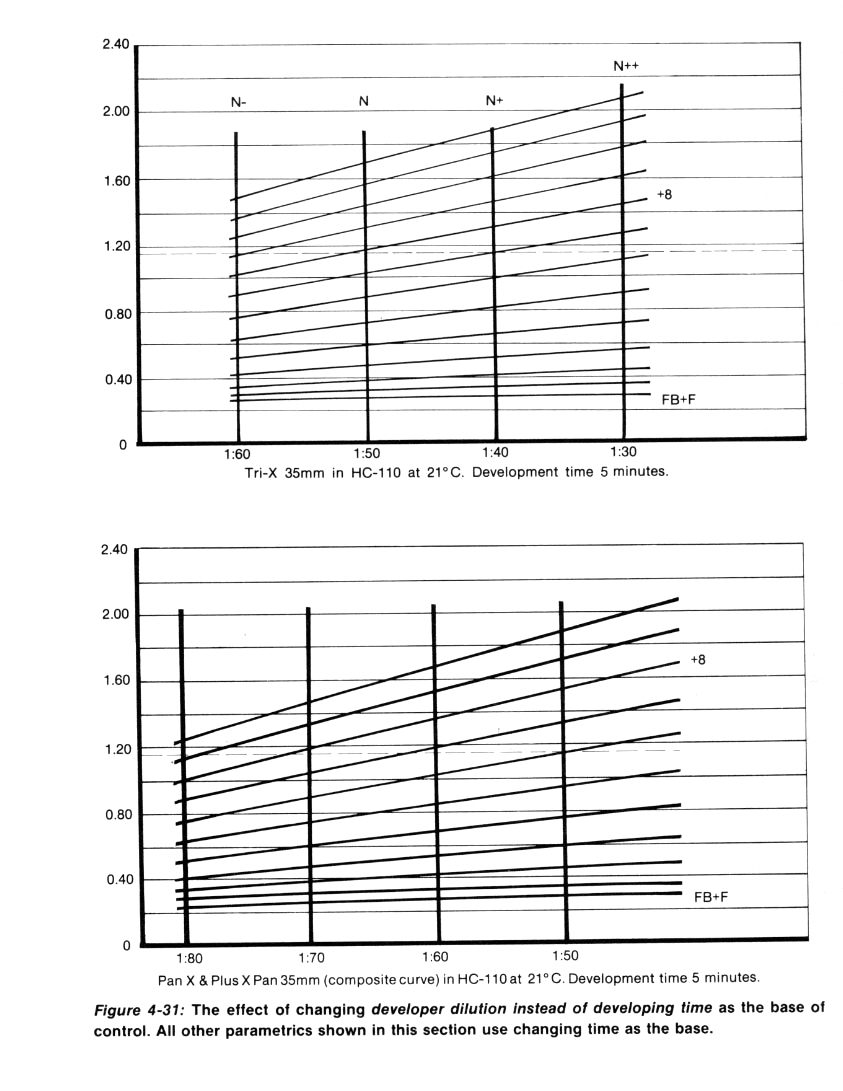
These curves show the equal separation in the shadows and also the contrast variations possible by merely varying the concentration of the HC-110 while keeping time, temperature and agitation constant.
The advantage of this system is that a widely distributed, very stable, highly concentrated commercially available developer of known quality is used only at a standard time— one which is physically long enough to avoid problems inherent in short developing time. The concentrated syrup can be measured accurately with pipettes, or this simple two step dilution schedule can be employed:
Make a working stock of 1 part developer and 9 parts water.
Do not mix more than what will be used in a few days.
Distilled water is recommended.
From there dilute the working stock in dilutions as follows to make dilutions of approximately:

*Total=450 ml for a two reel tank.
In my own approach to HC-110 I have always skipped the stock solution step and mixed my developer directly from the syrup. I also abandon Kodak’s letter system (dilution A, B, C etc) and use a ratio that is easy for me to remember and to mix. I used that with this system and when I use HC-110 in the more conventional way.
Gassan provides some recommended dilutions for a variety of films, but keep in mind a few things:
- These dilutions are from the 1:9 stock solution to approximate dilutions from the syrup (ratios in the left hand column).
- This data is from 1977 and films have changed
- He finds that a «decade change of dilution e.g. a change of 1:50 to 1:60 approximates a paper contrast grade». (for Kodak films, see below)
- The system works for Ilford films as well, but that they exhibit greater sensitivity to developer strength variations.
- There is almost no loss of shadow detail with this developer, even at the extreme dilutions.
All film is developed in HC-110 at 21C / 70F for five minutes with standard agitation.
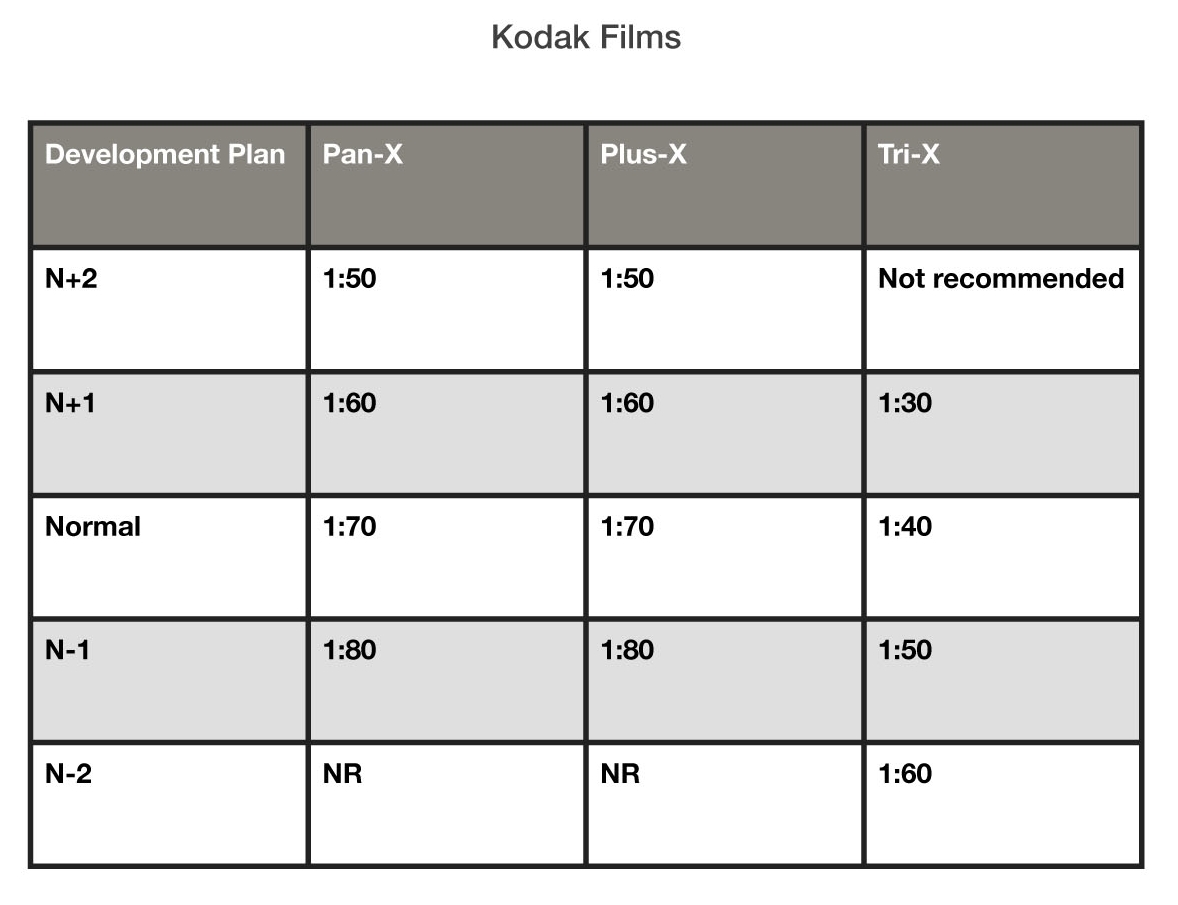
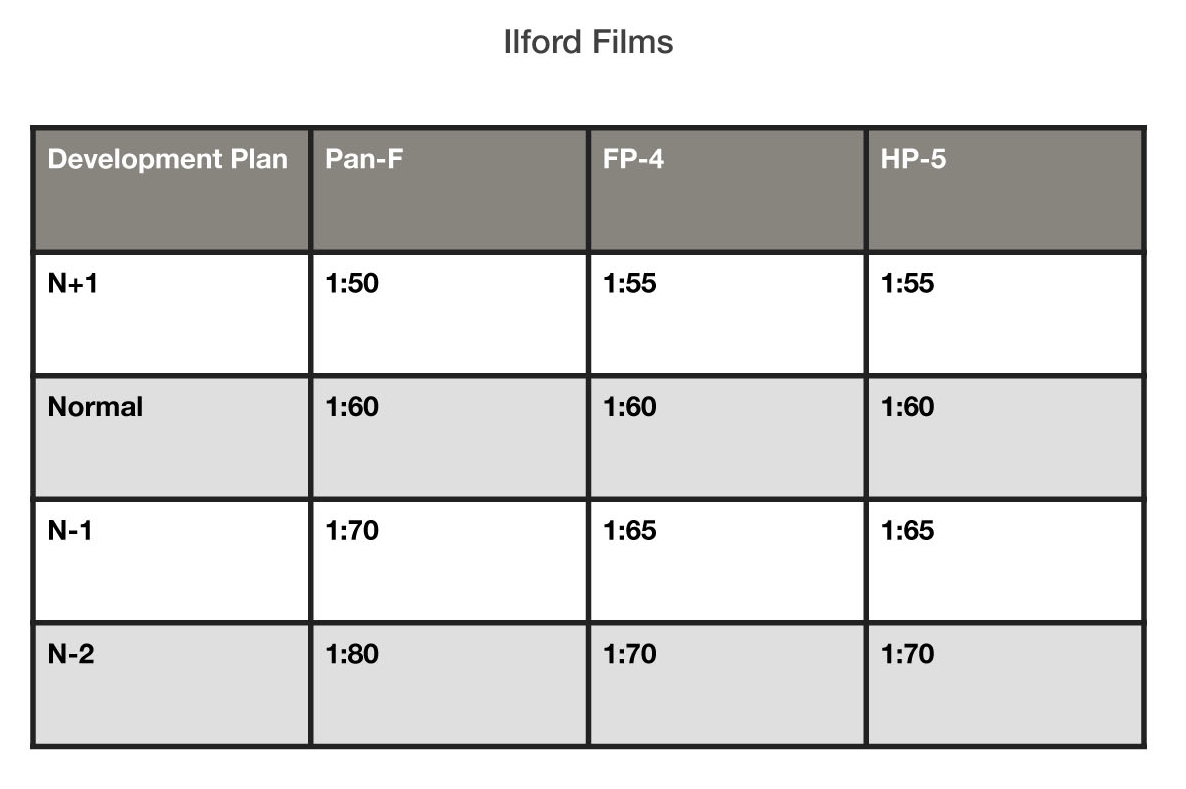
«N» meaning Normal contrast in zone system terminology
Gassan based these dilutions on a goal of developing a highlight density [zone VIII], to a density of 1.15 above FB+F.
He concludes with this insight into his approach to 35mm photography:
The whole purpose of this control system is to produce high quality, low density negatives that will print easily and well, rather than to «push» film. High energy developers produce high densities under extreme low light levels. And they also produce negatives that are more graphic and less tonal — that are not so much translations of colors into the grey scale of the photographs as they are graphic simplifications of the world.
The sense of graininess in 35mm is affected by exposure far more than most photogaphers are willing to admit. A correctly exposed minimum density negative is «filmy»; this means that the page of a book can be read easily while looking trough the negative. The least overexposure will mar otherwise excellent negatives that would enlarge well and have maximum resolution of detail. Two stops overexposure will enlarge the grain so much that the maximum degree of enlargement with out obvious grain is about 6 diameters.
I’ve no doubt that many of his former students remember him saying «make a negative that prints easily and well. «
I’ve used this system myself and found that it worked quite well with Ilford HP-5. My «normal» was 1:55 for 5 minutes at 70˚F. That was over 20 years ago, so please take that, and all of this as starting point for your own testing.